


THE ITF'S RWANDAN JOURNEY
29th May 2026
Everybody has dreams, and so did the International Transformation Foundation (ITF). The organization started an initiative dubbed “ITF Dream Challenge” to expand its operations in other countries. Operated through the international relations department, the initiative’s goal was to set up ITF in developing and developed countries to ensure organizational global presence and sustainability. Through this dream, in March 2018, our Rwandan office was ‘born’.
So why Rwanda? The International Transformation Foundation established ITF Rwanda to address a critical barrier to education: lack of clean water. Aligned with Rwanda's Education Sector Strategic Plan, ITF replicated its "Water Kiosk at School" model to stop children from missing school to fetch water. By installing sustainable tap water systems at schools, ITF Rwanda ensures students stay in class while communities gain affordable clean water and basic business management training, tackling dropout risk and improving livelihoods simultaneously.

A Water Kiosk at School is a unique social innovation designed to provide reliable access to clean water for schools and surrounding communities while equipping young learners with entrepreneurial skills and helping schools generate their own income. Installed in a school located in a community without tap water, the kiosk becomes the main clean water source for all households, bringing multiple benefits: financially, the money raised by students supports WASH activities in the school; educationally, attendance rates rise because children no longer miss school to fetch water for their families, and running the kiosk teaches them practical business skills; in terms of health and sanitation, access to clean water improves sanitation facilities and reduces waterborne diseases; and socioeconomically, children can carry water home directly from school, avoiding dangerous or distant water sources.
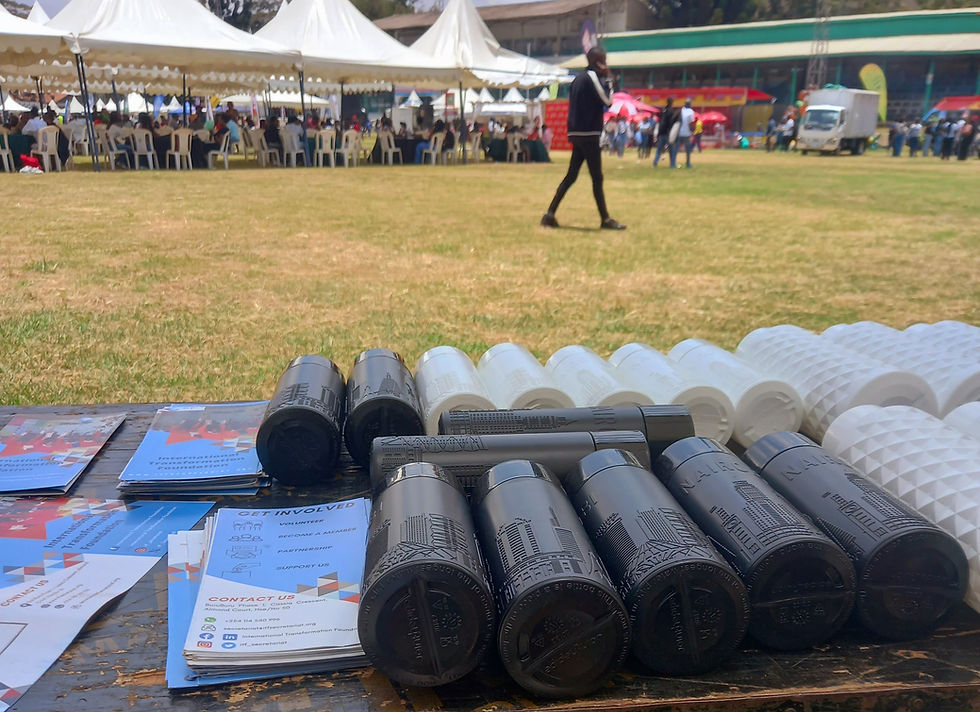
The Rwandan office was mainly created for the establishment of water kiosks, mainly focusing on Muhanga district, which is in the Southern Province of the country. In December 2017, ITF partnered with the Rwandan government through the Ministry of Education to replicate this model and improve educational outcomes for children lacking access to clean water. To date, across both Kenya and Rwanda, ITF has built 15 water kiosks in 15 communities, ensuring that 8,401 school children no longer miss school for water, 87,265 community residents have access to clean tap water, and 13,619 reusable water bottles have been distributed.
ITF's Water Kiosk at School project in Rwanda has been successfully implemented at three primary schools, each serving a unique community. At Bikombe Primary School, located in Kiyumba Sector in Muhanga district, the project benefits 800 students, 13 teachers, and 4,126 community residents. At Munini Primary School, located in Nyangoma Sector in Muhanga District, it serves 845 students, 20 teachers, and about 2,000 community residents. At Rubugurizo Primary School, located in Shyogwe Sector in Muhanga District, the project reaches 1,465 students and about 5,000 community residents. These figures demonstrate the varying scales of impact across different school communities, with the total reach spanning 6,436 students, 33 teachers, and 7,800 community members across the three sites.
While these successful installations highlight the profound impact of our initiatives, true progress also requires acknowledging where the journey is still underway. In Rutarabana Primary School in Nyamabuye Sector, Muhanga District, the narrative takes a more complex turn; here, the school’s project remains incomplete, currently at a standstill due to persistent water connection challenges. Including this stark contrast isn't just about showing the hurdles we face but about presenting an honest, transparent account of our operations—proving that sustainable development is a journey of both celebrated triumphs and ongoing perseverance.

One significant challenge encountered during the implementation of the Water Kiosk at School projects in Rwanda was the physical inaccessibility of the target areas. Schools such as Bikombe are located in remote, rural communities with poor road infrastructure, making it difficult to transport construction materials, water connection equipment, and kiosk components to the installation sites. During rainy seasons, roads became impassable, causing project delays and increasing logistical costs. The key lesson learned was the importance of conducting thorough site assessments and developing contingency plans for transportation before project commencement. ITF now works closely with local government authorities to identify alternative routes and schedule construction during dry seasons to minimize disruptions. This experience reinforced that delivering clean water to the most underserved communities requires not only technical solutions but also adaptive planning to overcome geographic barriers.

The achievements of ITF Rwanda must be understood within the distinct administrative and operational environment of the organization. As a youth-led, volunteer-driven nonprofit, ITF has always operated with immense passion but exceptionally lean administrative resources. Facing the substantial financial barriers typical of non-profit organizations, maintaining fully staffed, independent country offices presented a continuous challenge. These resource constraints demanded a high level of operational efficiency, discipline, and creative problem-solving to successfully stretch limited funding and manage internal systems. Ultimately, these structural realities directly informed the development of ITF’s new 10-Year Strategy (2026–2035). To secure long-term sustainability, the organization is currently transitioning away from isolated country operations, like the Rwanda office, and shifting toward a consolidated regional hub model across East, West, Central, and Southern Africa. This strategic reorganization is designed to significantly reduce administrative overhead while safeguarding program quality and expanding ITF's regional impact over the next decade.
With this change, the ITF board concluded that it would be best not to renew the Memorandum of Understanding (MoU) with the Ministry of Education in Rwanda that had already existed for the ten years the Rwandan office was in operation. Thus, in December 2025, ITF officially closed its Rwandan office. However, our work in Rwanda continues through local partnerships, where we support organizations replicating the Water Kiosk at School model. We are also collaborating with district authorities to install public water fountains, expanding access to clean water beyond school environments.
Though ITF’s main focus was on water kiosks at school in Rwanda, the organization’s current ongoing project is the Muhanga Water Fountain Project. The tangible impacts of ITF’s Public Drinking Tap Water Fountain project are evident across economic, environmental, and civic dimensions. By establishing free hydration points in high-traffic urban centers, the initiative directly alleviates financial strain on low-income commuters and street vendors who would otherwise spend a significant portion of their daily earnings on bottled water. Environmentally, the project serves as a powerful deterrent to urban pollution: ITF actively reduces single-use plastic consumption at the source, preventing thousands of bottles from clogging the district’s drainage systems. Furthermore, the integration of specialized, vandal-resistant infrastructure with auto-stop taps guarantees strict water conservation, proving to municipal governments that public utility projects can be both resilient and resource-efficient. Ultimately, the project demonstrates a scalable model for sustainable urban health and environmental stewardship."
The fight continues; the journey has just begun. ITF remains hopeful and committed to creating an even more impactful effect in Rwanda and beyond, reaching more schools, more communities, and more lives with clean water. Every challenge overcome strengthens our resolve, and every kiosk installed is a step toward lasting change. The work is far from done, but with continued partnership and dedication, the vision of water for all is steadily becoming a reality.
Written by Wilkister Oluoch
Supported by Isaack Nalwa


L'articolo è redatto con competenza e offre informazioni affidabili. Le informazioni sono ben documentate e sembrano affidabili. Ho salvato il link per condividerlo con chi potrebbe trovarlo utile. È un articolo che offre un quadro chiaro e completo della questione.